


Introducing disruptive technology… in a nutshell
More milk and more dry matter intake, from transition through peak lactation.
A breakthrough in the process for producing cashew nutshell extract (CNSE), followed by extensive research, led to DynOmik™: a patented, all-natural feed additive for dairy herds.
DynOmik™ is for dairy farmers and nutritionists who want a better bottom line from higher milk production and a more sustainable operation with a smaller carbon footprint.


More nutrient intake
Encourages higher dry matter intake, starting in fresh cows.

More milk
Proven in university research and confirmed on commercial dairies.

Greater sustainability
A plant-based cashew co-product that works with the cow's own rumen.

Smaller carbon footprint
Less unproductive carbon output. As milk per cow rises, methane per unit of milk falls.

DynOmik™
More milk, smaller footprint
DynOmik™ is a feed additive derived from cashew nutshell extract. It is for dairy farmers and nutritionists who want higher milk production and a more sustainable operation.
- Increases intake and nutrient availability
- Shifts VFA production toward propionate
- Reduces unproductive carbon output
- Lowers the farm's carbon footprint

Specifications
- Feeding rate
- 2.5–5 g/head/day
- Pelletable
- Up to 80°C (176°F)
- Packaging
- Box with two 5 kg bags
- Shelf life
- 24 months
- Particle size
- 200–400 μm
- Appearance
- Granular; milky white to brownish red
The science
How DynOmik™ shifts rumen fermentation to put more energy into milk.
How DynOmik™ works
More intake in fresh cows creates the foundation for better performance and cow health.
More intake
DynOmik™ increases dry matter intake and the nutrient load available to the cow.
A rumen shift
Greater nutrient availability shifts volatile fatty acid (VFA) production toward propionate.
Less wasted carbon
More propionate means less unproductive carbon output and a smaller farm carbon footprint.
More milk
The extra energy supports higher milk production from transition through peak lactation.
Greater DMI and nutrient load influences VFA production
| DynOmik™ (µg/mL) | 0 | 50 | 100 | 200 | SEM | P linear | P quadratic |
|---|---|---|---|---|---|---|---|
| Total VFA, mM | 115b | 127ab | 127a | 125ab | 1.4 | 0.14 | 0.05 |
| Acetate, mM | 50a | 51a | 51a | 43b | 0.7 | 0.11 | 0.03 |
| Propionate, mM | 27c | 31b | 37a | 39a | 0.6 | 0.04 | 0.01 |
| Butyrate, mM | 16b | 17a | 16b | 14c | 0.2 | 0.21 | 0.04 |
| pH | 6.59a | 6.48b | 6.40c | 6.48b | 0.01 | 0.21 | 0.05 |
a–c Means within a row with different superscripts differ (P < 0.05). Conducted as a semi-continuous culture experiment. Watanabe et al., 2010. J. Dairy Sci. 93:5258. Source: DynOmik™ brochure.
The proof
University research and on-farm results.
Proven in research and on the farm
Four trials, one consistent result: more intake and more energy-corrected milk
Fresh cows: more intake and more milk from day one
51 multiparous Holstein cows fed DynOmik™ from 21 days before calving. After calving: control vs. 2.5 or 5.0 g/cow/day, measured over the first 28 days in milk.
More intake in fresh cows builds the foundation for better performance and cow health.
*Average of the 2.5 and 5.0 g doses. At 2.5 g/cow/day alone: +2.4 lb/d dry matter intake and +7.6 lb/d ECM over the first 28 days in milk.
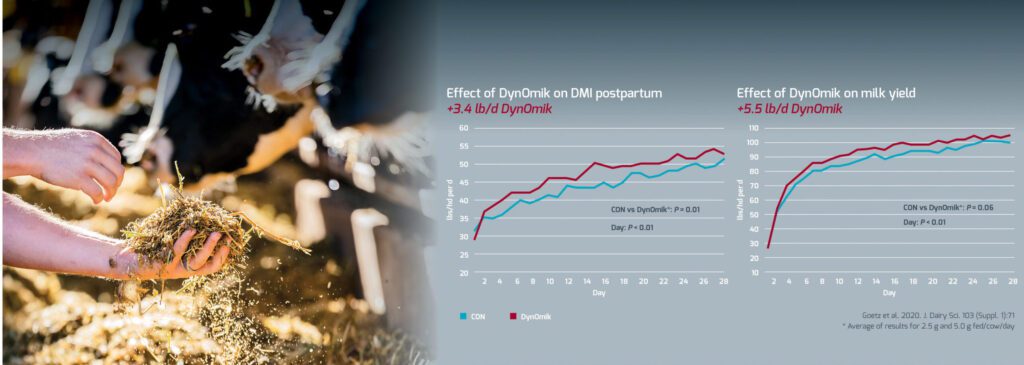
References: Goetz et al., 2020, J. Dairy Sci. 103 (Suppl. 1):71. Goetz et al., 2023, J. Dairy Sci. 106:9843–9854, read the paper.
Mid-lactation cows: +7.0 lb ECM with DynOmik™ in the robot pellet
117 Holstein cows (39 first-lactation, 78 older cows) averaging 100 days in milk, milked with 8 DeLaval voluntary milking systems. DynOmik™ was fed in the robot pellet at 0, 2.5 or 5.0 g/cow/day.
2.5 g/cow/day was the sweet spot. Doubling to 5 g/day added no extra ECM and cows ate less pellet, so start at 2.5 g/head/day.
De novo fatty acids in milk also increased with DynOmik™ (P = 0.03). Milk protein content, MUN and body weight were unchanged. Yields converted from kg/day.
Energy-corrected milk, lb/cow/day (P = 0.04)
+7.0 lb ECM at 2.5 g/dReferences: Schuling, S. E., D. E. Schimek and M. Engeseth, 2025. Optimal dose of cashew nutshell extract on milk and milk component production in lactating cows. J. Dairy Sci. 108 (Suppl. 1), Abstract 2451 (ADSA 2025 abstracts).
On-farm: +2.1 lb ECM for about $0.06/cow/day
A controlled field trial in Summer 2025 on 20 commercial dairies. 10 DynOmik™ farms vs. 10 control farms, about 37,700 cows producing roughly 90 lb of milk.
How the trial was run
- 20 commercial dairies10 fed DynOmik™ and 10 served as controls: 20,733 DynOmik™ cows vs. 16,981 control cows, all producing about 90 lb of milk.
- One change to the rationBasal diet vs. the same basal diet + 2.5 g/cow/day DynOmik™. All diets contained monensin.
- 7 weeks of feedingDynOmik™ feeding started around June–July 2025.
- Adaptation period removedThe first 3 weeks were dropped to allow for rumen adaptation.
- A fair comparisonA 7-day rolling average smoothed daily data, and differences were adjusted for each group's pre-trial baseline.
Results over time
Both groups started level during the pre-trial baseline (weeks −4 to −1). After the rumen adaptation period, the DynOmik™ farms pulled ahead and stayed ahead through week 7. Click any chart to enlarge.


Relative difference between treatments was adjusted for pre-trial baselines.
A simple, low-cost rumen shift that held up across about 37,700 cows on working dairies.
Source: Adisseo controlled field trial, Summer 2025. Full results in the DynOmik™ Update Series: Proof from the Field, Vol. 1 (SmartMail).
Two transition-cow herds: +3.5 and +6.4 lb milk/cow/day
Two commercial dairies, about 1,500 cows at transition each, fed DynOmik™ vs. control.
Dairy 1
Milk yield, lb/head/day
+3.5 lb milk/head/day| Component | Control | DynOmik™ |
|---|---|---|
| Milk fat | 4.11% | 4.59% |
| Milk protein | 3.06% | 3.10% |
Dairy 2
Milk yield, lb/head/day
+6.4 lb milk/head/day| Component | Control | DynOmik™ |
|---|---|---|
| Milk fat | 4.10% | 4.22% |
| Milk protein | 3.21% | 3.14% |
Source: on-farm demonstrations reported in the DynOmik™ brochure.

More milk. Smaller footprint.
Ask your Adisseo representative how DynOmik™ fits your fresh-cow and lactating rations.