



The prior three posts covered the trends in milk pricing in 2025. This post will use that data to estimate where producer milk prices may be going in 2026.
BUTTER
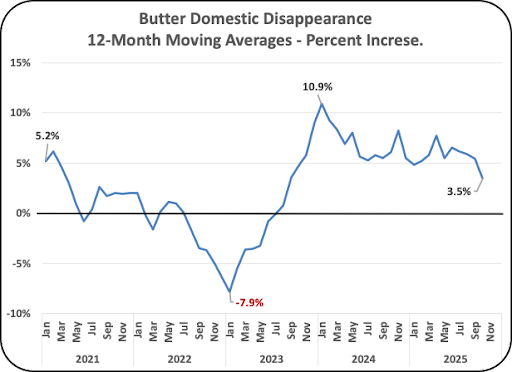
Butter demand grew rapidly in 2023 and has put pressure on inventories. Chart I below traces the domestic disappearance from inventories. The growth rate peaked at 10.9% annually in the beginning of 2024 and has slowed to 3.5% at the end of 2025. While the growth rate has slowed it is still at a robust annual increase in domestic disappearance.
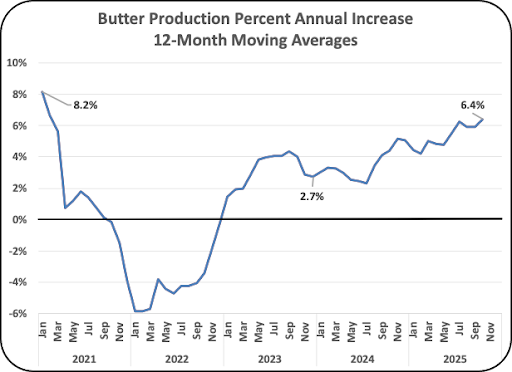
Butter production increased much slower. When domestic demand was peaking at 10.9%, production was increasing by only 2.7% in 2023 (Chart II). This put pressure on inventories and prices increased. The growth in production accelerated in 2025, reaching a record growth rate of 6.4% annually in 2025. That is nearly twice the 2025 domestic disappearance rate covered in Chart I.
In 2021, inventories of butter fell at the rate of 21.5% with strong demand and low production. With the low inventories, butter (and butterfat) prices rose to a record high in 2022. In 2023, with the help of imports, inventories increased (Chart III).
By 2025, with the increased production (Chart II above), inventories maintained adequate levels without imports. This also allowed exports to increase by 120%.
With slower growth in domestic disappearance of butter, adequate supplies in cold storage, increasing production rates, and increasing exports, the balance between supply and demand appears to be in balance. The supply of butter is plentiful enough to continue reducing prices for butter and therefore butterfat. It will also allow for stable exports.
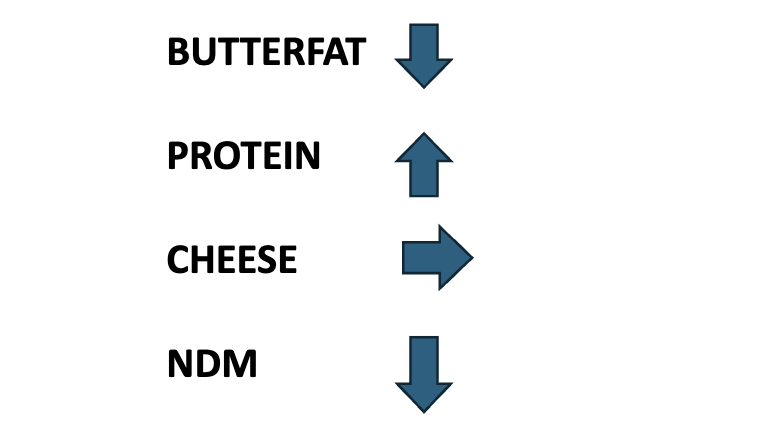
As a result, the price for butterfat will continue to drop in 2026.
CHEESE
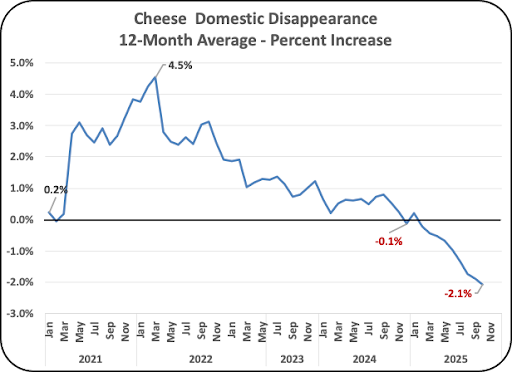
Cheese prices grew fast in 2021 when overall inflation was high. However, the rate of growth in domestic disappearance declined from 2022 through 2025. In 2025 the domestic disappearance growth rate went negative (Chart IV). The decrease in domestic cheese purchases is driven by shifting consumer preferences toward health.
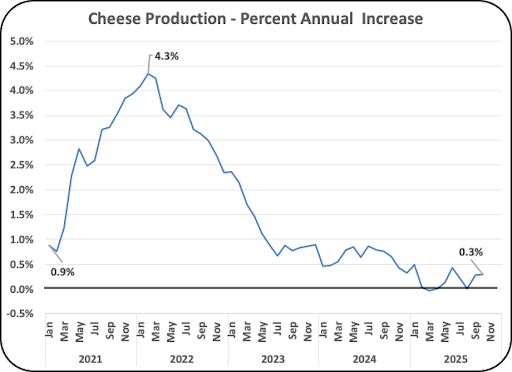
Cheese production followed a similar pattern but remained slightly positive in 2025 (Chart V).
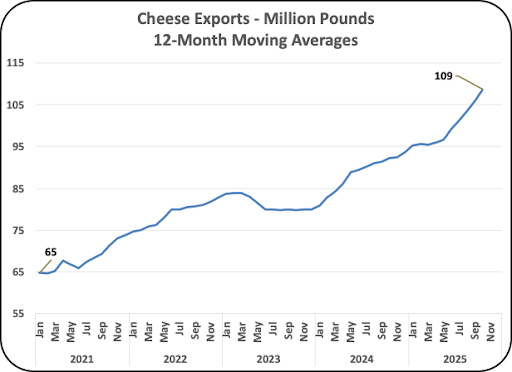
Cheese inventories decreased in 2024 and 2025 (Chart VI). How is that possible? Chart VII shows the increase in exports which are reaching record highs in 2025 (Chart VII). The U.S. is making more cheese than the U.S. can eat! That resulted in lower prices as covered in a prior post.
Cheese Domestic Disappearance decreased in 2025 and is continuing to shrink. Growth in production of cheese has remained slightly positive (Chart V). Some cheese must be exported.
The most likely case is that consumption, production and inventories will remain level in 2026 and maintain the current prices.
The decreasing price of butterfat will provide some small benefit by providing a slight increase in protein prices. Exports will continue to increase with lower prices than domestic cheese products. Exports are now at 9% of production.
Putting it all together will result in 2026 cheese prices that will remain at current levels or perhaps with some decline. No increase in cheese prices should be expected.
PROTEIN
Protein prices have increased significantly in 2025. Will they continue in 2026? Protein is priced based on Cheese and Butterfat Prices. As stated above, butterfat prices will likely continue to drop which will increase the Protein price. Cheese prices will likely remain near current prices.
Cheese inventories have fallen with the increase in exports (Chart VII above). The keys to increasing protein prices are for butterfat prices to continue to decline and cheese prices to increase.
Cheese prices will most likely remain stable or decrease slightly, and butterfat prices will continue to fall. That will result in higher Protein prices in 2026.
OTHER SOLIDS
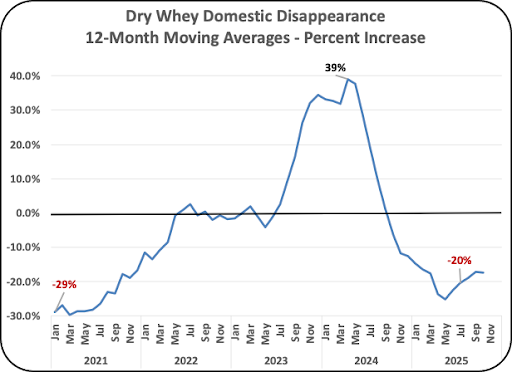
Other Solids are priced based on the price of Dry Whey. As shown in the Part I post of this series, Dry Whey prices are up by 50%. This typically reduces domestic disappearance and increases exports. Political events may impact the growth in exports of whey which will change the price of Dry Whey. China is a major importer of Whey Permeate.
NONFAT DRY MILK
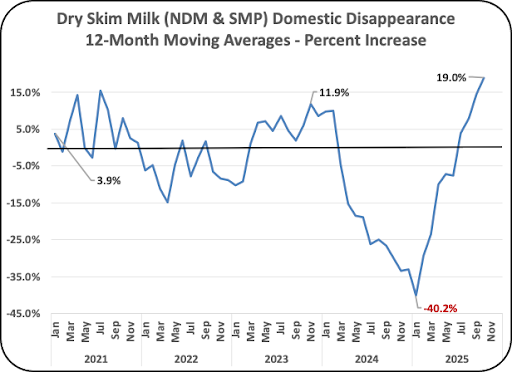
Nonfat Solids availability will be abundant with growing butter consumption and production. In 2024 and 2025 Domestic Disappearance fell and then grew to new highs to “catch up.” NDM consumption will find a home, but most likely at a lower price.
The prior three posts covered the trends in milk pricing in 2025. This post will use that data to estimate where producer milk prices may be going in 2026.
BUTTER
Butter demand grew rapidly in 2023 and has put pressure on inventories. Chart I below traces the domestic disappearance from inventories. The growth rate peaked at 10.9% annually in the beginning of 2024 and has slowed to 3.5% at the end of 2025. While the growth rate has slowed it is still at a robust annual increase in domestic disappearance.
Butter production increased much slower. When domestic demand was peaking at 10.9%, production was increasing by only 2.7% in 2023 (Chart II). This put pressure on inventories and prices increased. The growth in production accelerated in 2025, reaching a record growth rate of 6.4% annually in 2025. That is nearly twice the 2025 domestic disappearance rate covered in Chart I.
In 2021, inventories of butter fell at the rate of 21.5% with strong demand and low production. With the low inventories, butter (and butterfat) prices rose to a record high in 2022. In 2023, with the help of imports, inventories increased (Chart III).
By 2025, with the increased production (Chart II above), inventories maintained adequate levels without imports. This also allowed exports to increase by 120%.
With slower growth in domestic disappearance of butter, adequate supplies in cold storage, increasing production rates, and increasing exports, the balance between supply and demand appears to be in balance. The supply of butter is plentiful enough to continue reducing prices for butter and therefore butterfat. It will also allow for stable exports.
As a result, the price for butterfat will continue to drop in 2026.
CHEESE
Cheese prices grew fast in 2021 when overall inflation was high. However, the rate of growth in domestic disappearance declined from 2022 through 2025. In 2025 the domestic disappearance growth rate went negative (Chart IV). The decrease in domestic cheese purchases is driven by shifting consumer preferences toward health.
Cheese production followed a similar pattern but remained slightly positive in 2025 (Chart V).
Cheese inventories decreased in 2024 and 2025 (Chart VI). How is that possible? Chart VII shows the increase in exports which are reaching record highs in 2025 (Chart VII). The U.S. is making more cheese than the U.S. can eat! That resulted in lower prices as covered in a prior post.
Cheese Domestic Disappearance decreased in 2025 and is continuing to shrink. Growth in production of cheese has remained slightly positive (Chart V). Some cheese must be exported.
The most likely case is that consumption, production and inventories will remain level in 2026 and maintain the current prices.
The decreasing price of butterfat will provide some small benefit by providing a slight increase in protein prices. Exports will continue to increase with lower prices than domestic cheese products. Exports are now at 9% of production.
Putting it all together will result in 2026 cheese prices that will remain at current levels or perhaps with some decline. No increase in cheese prices should be expected.
PROTEIN
Protein prices have increased significantly in 2025. Will they continue in 2026? Protein is priced based on Cheese and Butterfat Prices. As stated above, butterfat prices will likely continue to drop which will increase the Protein price. Cheese prices will likely remain near current prices.
Cheese inventories have fallen with the increase in exports (Chart VII above). The keys to increasing protein prices are for butterfat prices to continue to decline and cheese prices to increase.
Cheese prices will most likely remain stable or decrease slightly, and butterfat prices will continue to fall. That will result in higher Protein prices in 2026.
OTHER SOLIDS
Other Solids are priced based on the price of Dry Whey. As shown in the Part I post of this series, Dry Whey prices are up by 50%. This typically reduces domestic disappearance and increases exports. Political events may impact the growth in exports of whey which will change the price of Dry Whey. China is a major importer of Whey Permeate.
NONFAT DRY MILK
Nonfat Solids availability will be abundant with growing butter consumption and production. In 2024 and 2025 Domestic Disappearance fell and then grew to new highs to “catch up.” NDM consumption will find a home, but most likely at a lower price.
The prior post showed that the producer price of butterfat is continuing …
Where are butterfat prices going in 2026? The answer is Down, Down …
After reading the headline, many readers are probably wondering “Why is this …
The prior posts reviewed the amazing gains in producer productivity. Increases in …