

The prior post provided detail on cheese prices, domestic consumption and growing cheese exports. This post will go deeper.
The cheese prices covered are for Cheddar cheese. Cheddar cheese prices are used to calculate protein prices for producers. Most cheese exports are also Cheddar cheese. Domestic consumption of cheese is growing at 1.3% annually. Exports are growing at 27% annually.
The wholesale price of Cheddar cheese is currently at $1.62 per pound. That figure is used in calculating the price of milk protein. Exports of cheese are averaging $2.00 per pound. The current domestic retail price is $5.74 per pound (Chart I). That price is close to the average price for the last two years.
The wholesale price of cheese which is used to price milk protein has decreased by 16% compared to the average of the last two years. The retail price has decreased by only 2%.
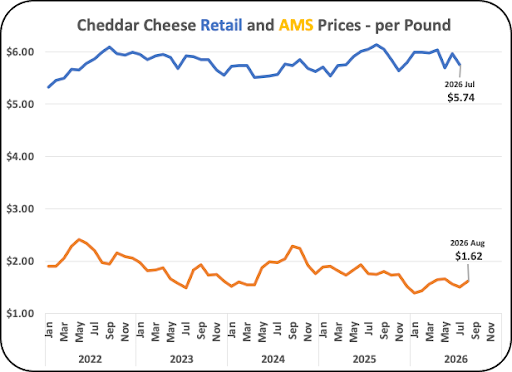
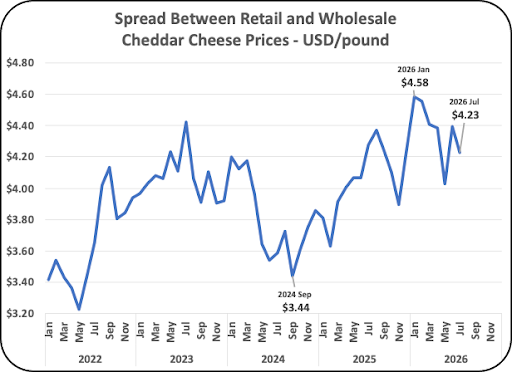
Chart II below shows the change in the spread between retail and wholesale Cheddar cheese. The conclusion is simple. Producers are getting less revenue. Processors of cheese and sales of cheese in retail stores are making more revenue.
Ideally, the retail price of cheese will begin falling with lower wholesale prices, thereby increasing domestic consumption.
The cheese that is exported is primarily blocks of cheese, just like the wholesale cheese used to price milk protein. They both depend on the Chicago Mercantile Exchange for sourcing. (The current Agricultural Marketing Service (AMS) now uses only block prices for pricing wholesale cheese.)
Blocks of cheese hold up better in shipping and have a longer shelf life than processed cheese. The blocks can be processed into slices and other forms to meet local formats. The blocks do need equipment to move as they weigh roughly 200 pounds each.
The growth of cheese consumption domestically and a very significant increase in exports is an exciting venture. The trend to Ultrafiltered and Lactose free milk are helping to stabilize the decrease in consumption of fluid milk. Butter is another opportunity for export growth. Can the butter churners increase efficiency?
The downside is the necessary changing of the “way of life” for the dairy industry. The change in the dairy industry will eliminate small farms except for farms producing unique items. Many of the changes were in a prior post. “Beef on dairy” is another example, but it cannot work on small farms.
The result will be a very efficient high-tech industry that can bring consumers excellent products at reasonable prices. It will also help in global competition for exports that are financially attractive and have excellent quality. Dairy, like all businesses must always be moving forward. The change in cheese production and exports is leading the way. Canadian tariffs may make some temporary difficulty in cheese exports.