

Part I – Were Producer Milk Prices Good in 2025?

Part I – Were Producer Milk Prices Good in 2025?

This is the first of four posts that will review the 2025 producer milk pricing.  They will be compared to five other years starting in 2021.  Four different types of data will be covered.  The four types are shown below.  The charts are all expressed in six year moving averages to eliminate volatility.

  1. The price of commodities Including butter, nonfat dry milk, cheese, and dry whey.
  2. The price of components including butterfat, nonfat solids, protein, and other solids
  3. The prices of the four Classes of milk, Class I, II, III, and IV
  4. The fourth in this series is a projection of 2026 producer milk prices

COMMODITIES PRICES 

The prices of commodities are based on wholesale prices.  The commodities are listed above.  Except for Class I, the commodity prices used are based on the prices on the Chicago Mercantile Exchange.  Typically, the available inventories move the market prices.  If inventories are low, prices will be higher and vice versa.

          BUTTER

Below are the prices over six years.  Butter prices in 2020 and 2021 were influenced by COVID “Stay at Home” mandates as many restaurants were closed.  In 2021, the prices rose to new highs as research showed that butter from cows were not a health concern.  While butter is a saturated fat it does not clog arteries.  Butter does have high calories per pound but eaten in moderation butter is a healthy commodity.  Consumption grew quickly and U.S. production could not keep up and inventories were tight.  Production is catching up and inventories have increased.  With higher inventories, prices have fallen in 2025.
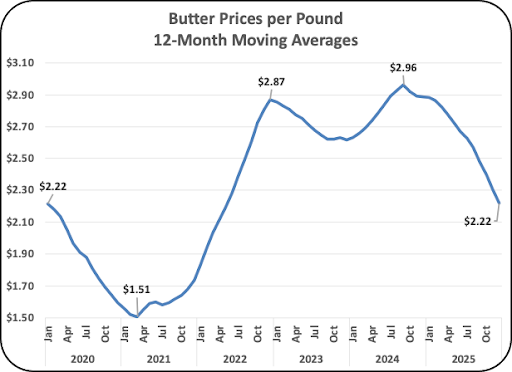
Chart I – Butter Prices

          NONFAT DRY MILK

Nonfat dry milk (NDM) prices increased in 2022 primarily due to a combination of tightening supplies from lower milk production and strong global demand, fueled by post-pandemic economic recovery and significant export activity, to markets like Mexico.  Lower cow numbers and slower milk per cow growth, partly due to high feed costs and drought, tightened the supply of milk available for processing milk into NDM.

In 2023, U.S. milk production ran high, leading to ample supply of dairy products. This, coupled with softer domestic demand, contributed to lower NDM prices. 
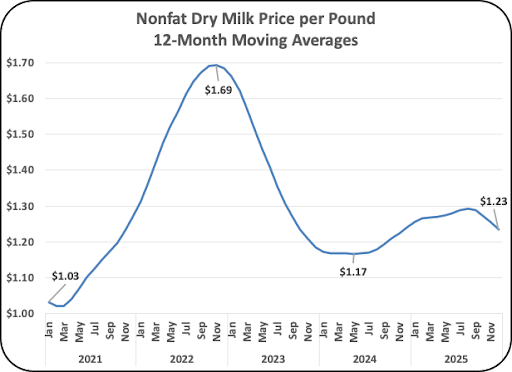
Chart II – Nonfat Dry Milk Prices

          CHEESE

In 2023 hotter temperatures led to dairy cows producing less milk, tightening the overall milk supply.  Robust international demand for U.S. cheese pulled supplies away from the domestic market.  As a result, the inventories of cheese were lower and prices were higher. By 2025, the Increased milk production in the U.S., the E.U., and New Zealand, surged and created and oversupply in the market that outpaced demand. Wholesale inventories grew and prices fell.  New large-scale cheese manufacturing plants came online, especially for American-style cheeses, which added significant capacity.  

Domestic demand was softer than anticipated, with a notable slump in sales at major pizza chains leading to less demand for Mozzarella cheese. The price of cheese fell by 50% from $3.24 to $1.53 per pound.

Chart III – Cheese Prices

          DRY WHEY

The significant fall in dry whey prices in 2022 and 2023 was primarily due to a combination of weakening global demand, a pullback in demand from China, and a strategic shift by manufacturers towards higher-value whey protein products, which initially created an oversupply of dry whey powder.   Higher inventories lead to lower prices.  Prices dropped by 50%.

Dry whey prices surged in late 2024 and early 2025 due to a significant drop in dry whey production (down over 10% in 2024) as dairy processors prioritized high-protein, high-margin products like whey protein combined with robust demand from health-focused consumers and international markets, the inventory of Dry Whey decreased.  In turn, this caused a 45% higher price of Dry Whey.
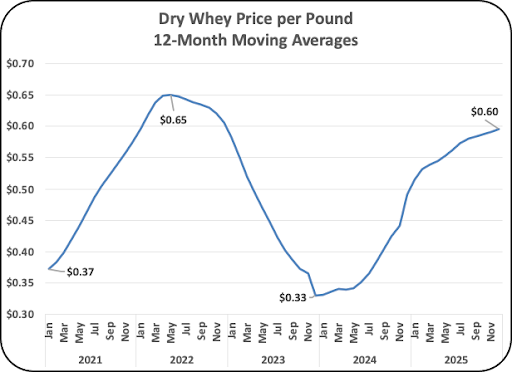
Chart IV – Dry Whey Prices

          SUMMARY

Over the course of 2021 through 2025, wholesale dairy products were very volatile.  In 2025 wholesale prices for butter, nonfat dry milk, and cheese were all down. Dry Whey prices were up by 45%.

The next post will follow the prices of the commodities listed above.  The prices of these commodities are calculated by formulas using the commodity prices covered in this post.

Other recent posts are available at this link, and older posts are available at this link.

Subscribe via email

This field is for validation purposes and should be left unchanged.

Get new posts by email:

Cheese

Dry Whey

Cash prices - Butter / Cheese

FMMO Price Announcements

Resources

Blog Archive

This is the first of four posts that will review the 2025 producer milk pricing.  They will be compared to five other years starting in 2021.  Four different types of data will be covered.  The four types are shown below.  The charts are all expressed in six year moving averages to eliminate volatility.

  1. The price of commodities Including butter, nonfat dry milk, cheese, and dry whey.
  2. The price of components including butterfat, nonfat solids, protein, and other solids
  3. The prices of the four Classes of milk, Class I, II, III, and IV
  4. The fourth in this series is a projection of 2026 producer milk prices

COMMODITIES PRICES 

The prices of commodities are based on wholesale prices.  The commodities are listed above.  Except for Class I, the commodity prices used are based on the prices on the Chicago Mercantile Exchange.  Typically, the available inventories move the market prices.  If inventories are low, prices will be higher and vice versa.

          BUTTER

Below are the prices over six years.  Butter prices in 2020 and 2021 were influenced by COVID “Stay at Home” mandates as many restaurants were closed.  In 2021, the prices rose to new highs as research showed that butter from cows were not a health concern.  While butter is a saturated fat it does not clog arteries.  Butter does have high calories per pound but eaten in moderation butter is a healthy commodity.  Consumption grew quickly and U.S. production could not keep up and inventories were tight.  Production is catching up and inventories have increased.  With higher inventories, prices have fallen in 2025.

Chart I – Butter Prices

          NONFAT DRY MILK

Nonfat dry milk (NDM) prices increased in 2022 primarily due to a combination of tightening supplies from lower milk production and strong global demand, fueled by post-pandemic economic recovery and significant export activity, to markets like Mexico.  Lower cow numbers and slower milk per cow growth, partly due to high feed costs and drought, tightened the supply of milk available for processing milk into NDM.

In 2023, U.S. milk production ran high, leading to ample supply of dairy products. This, coupled with softer domestic demand, contributed to lower NDM prices. 

Chart II – Nonfat Dry Milk Prices

          CHEESE

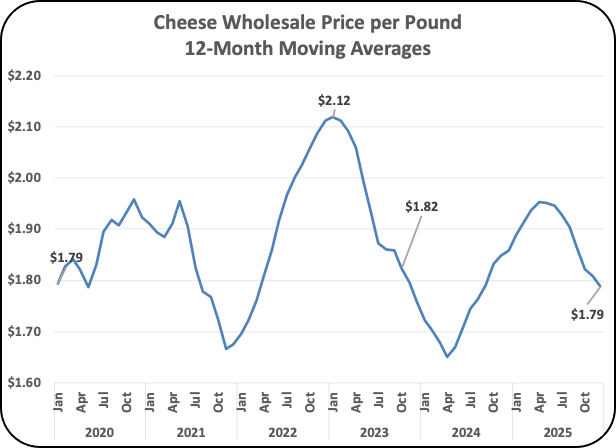
In 2023 hotter temperatures led to dairy cows producing less milk, tightening the overall milk supply.  Robust international demand for U.S. cheese pulled supplies away from the domestic market.  As a result, the inventories of cheese were lower and prices were higher. By 2025, the Increased milk production in the U.S., the E.U., and New Zealand, surged and created and oversupply in the market that outpaced demand. Wholesale inventories grew and prices fell.  New large-scale cheese manufacturing plants came online, especially for American-style cheeses, which added significant capacity.  

Domestic demand was softer than anticipated, with a notable slump in sales at major pizza chains leading to less demand for Mozzarella cheese. The price of cheese fell by 50% from $3.24 to $1.53 per pound.

Chart III – Cheese Prices

          DRY WHEY

The significant fall in dry whey prices in 2022 and 2023 was primarily due to a combination of weakening global demand, a pullback in demand from China, and a strategic shift by manufacturers towards higher-value whey protein products, which initially created an oversupply of dry whey powder.   Higher inventories lead to lower prices.  Prices dropped by 50%.

Dry whey prices surged in late 2024 and early 2025 due to a significant drop in dry whey production (down over 10% in 2024) as dairy processors prioritized high-protein, high-margin products like whey protein combined with robust demand from health-focused consumers and international markets, the inventory of Dry Whey decreased.  In turn, this caused a 45% higher price of Dry Whey.

Chart IV – Dry Whey Prices

          SUMMARY

Over the course of 2021 through 2025, wholesale dairy products were very volatile.  In 2025 wholesale prices for butter, nonfat dry milk, and cheese were all down. Dry Whey prices were up by 45%.

The next post will follow the prices of the commodities listed above.  The prices of these commodities are calculated by formulas using the commodity prices covered in this post.

Other recent posts are available at this link, and older posts are available at this link.

Subscribe via email

This field is for validation purposes and should be left unchanged.

Get new posts by email:

Cheese

Dry Whey

Cash prices - Butter / Cheese

FMMO Price Announcements

Resources

Blog Archive

New MilkPrice Resources

Check out our resources to learn more from MilkPrice!

This is the first of four posts that will review the 2025 …

Fluid milk sales declined in the U.S. starting in 2020 and continued …

The prior post covered the growth of milk production in the U.S.  …

The last post covered the growth in milk production.  The growth in …

Latest Blog