

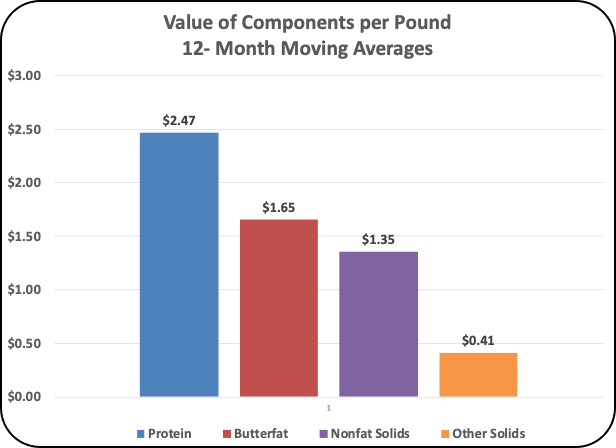
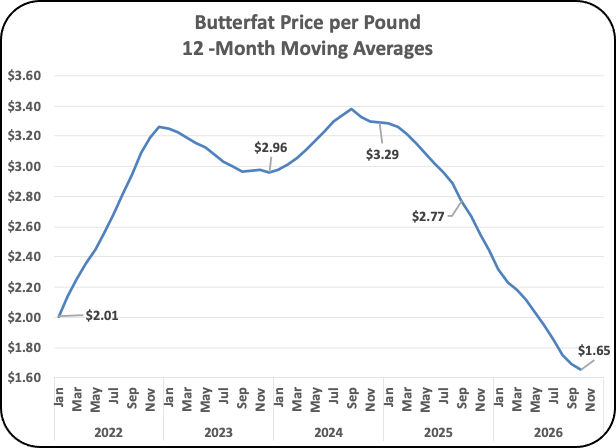
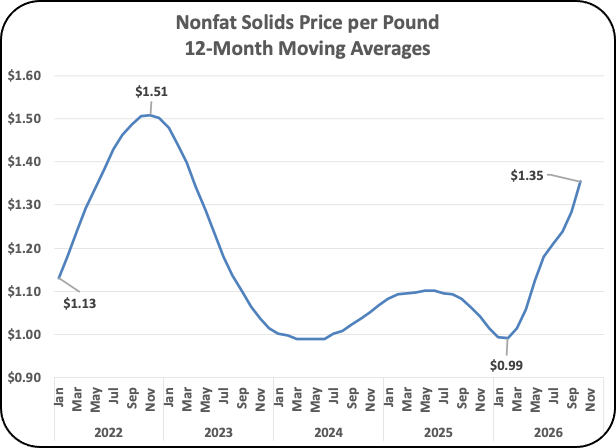
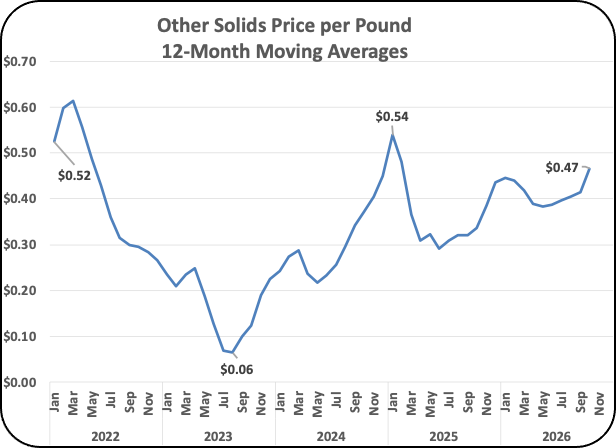
Many of the prior posts covered the rapidly changing U.S. dairy industry. The economics are also changing rapidly. This post will cover some of the changing economics. Chart I below shows the current pricing for milk components. The other Charts show the pricing trends for each of these components.
Dairy is financially very volatile. Dairy farmers have very little control of the monthly value of these four components. Much of the data used for these components are based on the Chicago Mercantile Exchange prices and the supply and demand.
There is one major element that will not be covered in this post. That is “Beef on Dairy” that has been developed quickly over the last four years. When used it can increase the revenue of dairy farmers by as much as $5.00 per cwt. Specific details are not readily available in USDA data, but an analysis will be attempted in a future post. It is a very big factor in revenue at the farm level.
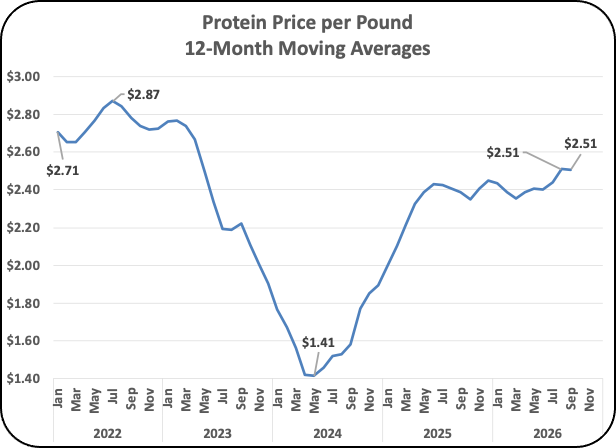
The Charts below are based on 12-month moving averages to reduce monthly volatility.
Protein is valuable only when the milk is used for cheese. Cheese is by far the largest dairy product, so protein pricing is very important. Protein is priced based on two variables, the price of cheddar cheese and the price of butterfat. When the protein is worth more in cheese than it is in butter, the extra value is credited to the protein. The price of butterfat, based on the wholesale price of butter, was very high in 2024, and that created a negative value for protein. The value of butterfat when used in cheese was worth less than when it was used for butter. The current low values for butter have increased the price of protein. The current price levels are at average prices.
Butterfat is paid to dairy farmers for all milk. All dairy farmers make more money when the price of butterfat is high. Unfortunately, U.S. butter consumption is not growing. Production is growing.
There is a strong need for butterfat in the growing cheese production. Because the productivity of butterfat in cows has increased faster than the increase in protein, the cheese makers have more butterfat than they need. (Butterfat percent in milk has increased by 9% over five years while Protein percent in milk has grown by 5%).
That leaves the excess butterfat going to butter churning which must be exported. Butterfat price per pound is at a five-year low.
Nonfat solids have good value. It is typically dried and sold as Nonfat Dry Milk (NDM) in the U.S. or as Skimmed Milk Powder (SMP) for export. These products have high protein, lactose, and all the other good things in milk except fat and water. It can be used in other products like ice cream, baked goods, processed foods, and nutritional products. They are heavily exported, which can increase pricing volatility. They are really a coproduct, not a byproduct. NDM and SMP have a very long shelf life.
Other Solids are what’s left over in the cheese making process. It is valued based on the price of dry whey. It currently has a steady price around $.50 per pound (Chart V).
Dry Whey is a byproduct of cheese making and is primarily sugar. In the form of whey permeate, it is a source for animal feeding to encourage growth. There is also whey protein that is not used in cheese and can therefore be a source of protein for other needs. The price is minimal, but there is a steady market in the U.S. and for export. Dry whey is not technically a “component” it is used to price “Other Solids”.
SUMMARY
In summary, the only component that is struggling in price is butterfat. The percent growth of butterfat in milk has slowed but it is still growing. Other export opportunities are needed, and the changing tariffs can make it difficult. Simply put, the U.S. just has too much butterfat!
Many of the prior posts covered the rapidly changing U.S. dairy industry. The economics are also changing rapidly. This post will cover some of the changing economics. Chart I below shows the current pricing for milk components. The other Charts show the pricing trends for each of these components.
Dairy is financially very volatile. Dairy farmers have very little control of the monthly value of these four components. Much of the data used for these components are based on the Chicago Mercantile Exchange prices and the supply and demand.
There is one major element that will not be covered in this post. That is “Beef on Dairy” that has been developed quickly over the last four years. When used it can increase the revenue of dairy farmers by as much as $5.00 per cwt. Specific details are not readily available in USDA data, but an analysis will be attempted in a future post. It is a very big factor in revenue at the farm level.
The Charts below are based on 12-month moving averages to reduce monthly volatility.
Protein is valuable only when the milk is used for cheese. Cheese is by far the largest dairy product, so protein pricing is very important. Protein is priced based on two variables, the price of cheddar cheese and the price of butterfat. When the protein is worth more in cheese than it is in butter, the extra value is credited to the protein. The price of butterfat, based on the wholesale price of butter, was very high in 2024, and that created a negative value for protein. The value of butterfat when used in cheese was worth less than when it was used for butter. The current low values for butter have increased the price of protein. The current price levels are at average prices.
Butterfat is paid to dairy farmers for all milk. All dairy farmers make more money when the price of butterfat is high. Unfortunately, U.S. butter consumption is not growing. Production is growing.
There is a strong need for butterfat in the growing cheese production. Because the productivity of butterfat in cows has increased faster than the increase in protein, the cheese makers have more butterfat than they need. (Butterfat percent in milk has increased by 9% over five years while Protein percent in milk has grown by 5%).
That leaves the excess butterfat going to butter churning which must be exported. Butterfat price per pound is at a five-year low.
Nonfat solids have good value. It is typically dried and sold as Nonfat Dry Milk (NDM) in the U.S. or as Skimmed Milk Powder (SMP) for export. These products have high protein, lactose, and all the other good things in milk except fat and water. It can be used in other products like ice cream, baked goods, processed foods, and nutritional products. They are heavily exported, which can increase pricing volatility. They are really a coproduct, not a byproduct. NDM and SMP have a very long shelf life.
Other Solids are what’s left over in the cheese making process. It is valued based on the price of dry whey. It currently has a steady price around $.50 per pound (Chart V).
Dry Whey is a byproduct of cheese making and is primarily sugar. In the form of whey permeate, it is a source for animal feeding to encourage growth. There is also whey protein that is not used in cheese and can therefore be a source of protein for other needs. The price is minimal, but there is a steady market in the U.S. and for export. Dry whey is not technically a “component” it is used to price “Other Solids”.
SUMMARY
In summary, the only component that is struggling in price is butterfat. The percent growth of butterfat in milk has slowed but it is still growing. Other export opportunities are needed, and the changing tariffs can make it difficult. Simply put, the U.S. just has too much butterfat!
Many of the prior posts covered the rapidly changing U.S. dairy industry. …
The prior post covered the production growth of milk, cows, cheese and …
Starting in 2025, the dairy industry developed a strong and steady growth. …
The prior post covered volatility in dairy component prices. The protein price …