

The USDA report on sales of fluid milk lists categories such as whole milk, 2% milk, 1% milk, etc. There is one category, “Other”, which is a “catch all” for everything that does not fit in one of their categories. Traditionally, this category was very small, but it has increased by almost 600% in the last six years. One of the milk forms in “Other” is milk that is lactose free. Most of the increase in “Other” is ultra-filtered milk which is 100% lactose free and is sold by Coca Cola Co. and Costco, both marketing giants. The brand names are Fairlife and Kirkland.
Fluid milk sales were shrinking for many years (Chart II below). Now sales of Fluid milk are steady and may begin increasing. The reason is the increase in “Other” milk. The characteristics of this ultra -filtered milk include the following items.
Ultra-filtration – This technique pushes milk through a semipermeable membrane filter, allowing specific components of milk to pass through based on their molecular weight.
Lactose Free – Manufacturers add the enzyme lactase to regular milk which converts lactose into two simple sugars: glucose and galactose which are easily digested. This process mimics how the human body naturally breaks down lactose.
More protein and less sugar – The filtration process filters out some of the water which has soluable lactose and recombines the remaining components to concentrate the protein with less sugar. With less water, the protein is 50% higher. The lactose filtered out is used in animal feed to sweeten their food and some is treated with lactase to convert the lactose to glucose as a sweetener in human foods.
More Vitamin D and Calcium – Ultra-filtered milk also provides more vitamin D and calcium.
Nine Month shelf life – Ultra high temperatures for pasteurization heats the milk to higher temperatures than conventional pasteurization. This effectively sterilizes the milk by eliminating all harmful microorganisms and active bacteria.
More Expensive for Consumers – The Ultra-filtered milk which is processed to have higher protein, lower sugar and no lactose is priced at twice the price of regular milk.
The products with lower fat are less expensive to make but typically retail for the same price as whole milk. Cows today have over 4% butterfat and the excess butterfat above the listed amounts of 3.25%, 2.0%, etc. can be sold to butter churners at good prices. Costco’s ultra-filtered milk sells only 2.0% fat milk.
The milk products that are lactose free are included in the “Other” category and make up most of the volume in that category. These products have seen tremendous growth in the last six years (Chart I).
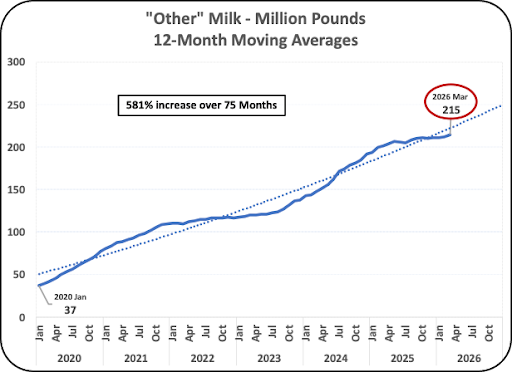
Chart II below shows the decline in milk sales which leveled out beginning in 2024.

The sales are split between conventional milk and organic milk as shown in Charts III and IV. Conventional sales are 94% of total milk sales and Organic milk is 7%. (The figures do not add up to 100% due to rounding.)


The major milk categories below show the current monthly volumes (Table I). All but “Other” are declining. Some is the normal downward trend of their sales and some of the decline is from cannibalization of the growing “Other” products. The “Other” category is already larger than fat free milk and may soon pass organic milk and 1% milk. Whole milk has minimally declined over five years, but 1% and 2% fat milk have declined by 22%.

The ultra-filtration products are processed foods, and generally processed foods are not considered healthy foods. However, none of the ingredients processed by ultra-filtration are any different than milk right out of a cow. The Ultra-filtration products are increasing milk consumption. That increases health.