Announcing The Charles Schwab Young Scientist Award
Calling all Young Scientists to apply!



Calling all Young Scientists to apply!
Balancing the essential amino acid levels in dairy rations has been proven as an effective nutritional tool at all stages of lactation.
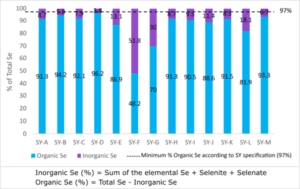
The recent advances in analytical methodologies have led to an increasingly more accurate, reliable, and comprehensive determination of the composition of seleno-yeasts.

Uncover the answers to questions like these, with deeper insights on the role of nitrogen emissions in the ruminant sector, as we interview Dr. Brian Sloan, Business and Technical Director Ruminant Amino Acids & Protected Nutrients, and Amel Hocini, Project Chief for Sustainability, with Adisseo USA.

In this article you will read about the negative performance affects caused by mycotoxins in dairy cows, and how Unike® Plus successfully mitigates these issues.
Nutrition has always played an important role in helping dairy cows meet various production expectations.

Last summer, Jason and Becky Mills had to increase their milk solids to meet their buyer’s new requirements. They did this through a range of management changes, most significant of which was feeding protected methionine.
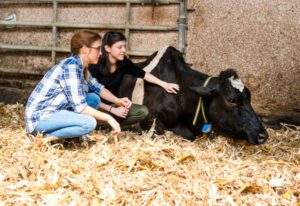
Adisseo continues to raise awareness on the significant benefits of meeting requirements for essential nutrients.
Methionine is an essential nutrient that fulfills wide-ranging roles in dairy nutrition. Its full impact on production, health, and reproductive performance continues to be explored more fully.
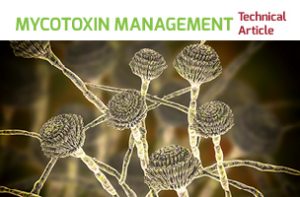
Grain is an important and significant source of contamination in the food chain and it also carries the risk of the consumers being exposed to toxins.

In animals and humans, Selenium deficiency is associated with compromised immunity and increased susceptibility to various diseases including the recent epidemic caused by COVID-19.
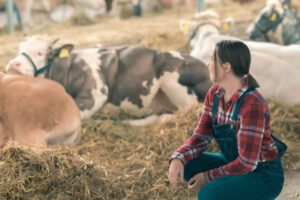
Introduced nearly 14 years ago, Metasmart® has remained without equal in the dairy industry.
For over 50 years, Adisseo has developed different solutions, in particular to stimulate voluntary feed intake and encourage the natural behavior of animals.
Listen as Greven, gives an introduction into the use of palatability solutions.
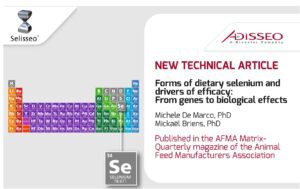
Selenium can be added to livestock diets in either inorganic forms (sodium selenite, SS), organic forms such as Se-yeast (yeast enriched in SeMet), or pure chemically synthesized Se forms such as hydroxyselenomethionine (HMSeBA), L-SeMet or ZnL-SeMet. Recent advances in Se biochemistry have provided a deeper understanding of the principal differences in absorption and metabolism between these forms.
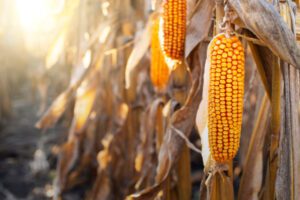
A total of 48 analyses were conducted to test for the occurrence of the 11 mycotoxins most commonly found in agricultural commodities intended for animal production.
Ketosis is a common disease. The estimated cost of subclinical ketosis is $67 USD per case per year.